

Description
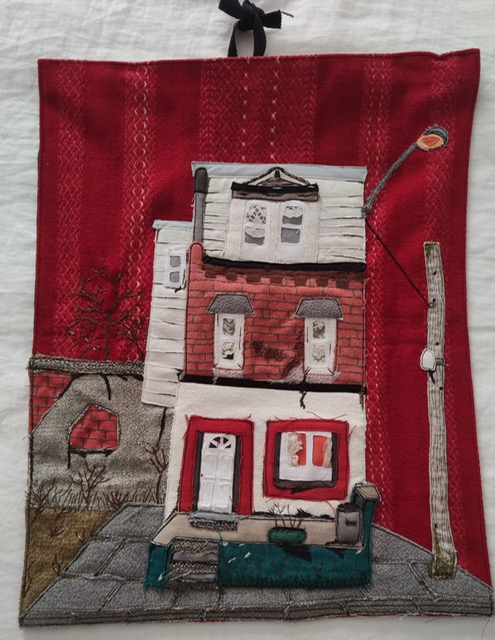
The scene unfolds like a fragment of a neighbourhood paused in time: a narrow, three-storey house resting on a grey pavement that marks the boundary between the private realm and the street. The façade combines white and brick red, with windows that suggest interior life without fully revealing it.
The background—a vibrant, textured red textile—does not attempt to depict sky or real landscape. Instead, it functions as an emotional atmosphere, enveloping the architecture in a kind of intensified memory. To the right, an embroidered streetlamp gently anchors the scene in the urban world; to the left, a wall and a barely suggested tree complete the setting.
Stitching remains visible, and layers of fabric overlap without fully concealing their edges. The technique reinforces a sense of manual construction: cutting, assembling, embroidering lines that draw windows, shadows, and cracks. Thread not only defines shapes; it introduces rhythm and depth.
In the work of Pili Iglesias, domestic architecture appears as shared memory. This is not a portrait of a specific building, but the activation of a recognisable image—the house as refuge, as the stage for small, everyday stories. The piece does not narrate an event, yet it suggests that something is happening behind those windows.
Hung on its own, it holds presence through chromatic contrast and the relief of embroidery. Shown alongside other textile works, it enters into dialogue through the everyday, maintaining the balance between intimacy and urban life that defines her practice.
This post is also available in: Spanish