

Description
In the 1920s and 1930s, when travelling theatres toured seaside towns, village squares and small wooden pavilions across the United Kingdom, the name Arthur Quisto (1882–1960) began to circulate among puppeteers, craftsmen and families who faithfully attended Punch & Judy performances.
Quisto belonged to that lineage of creators who understood puppetry as a total craft: he sculpted, painted, repaired and animated every character himself. He wasn’t just a maker—he was a performer who shaped, with his own hands, the very expression that would later come alive before the audience.
His work became so emblematic of 20th-century British popular theatre that several of his puppets are now preserved in the Victoria and Albert Museum in London, a recognition reserved for artists who left a mark on the performing arts in the UK.
The V&A catalogues these pieces as exceptional examples of English puppet craftsmanship, confirming Quisto’s importance in the theatrical imagination of his time.
https://collections.vam.ac.uk/item/O1247239/glove-puppet-arthur-quisto/
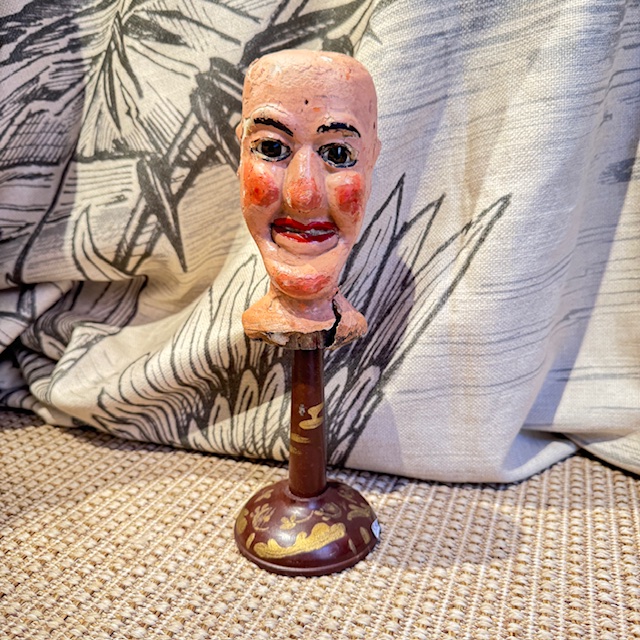
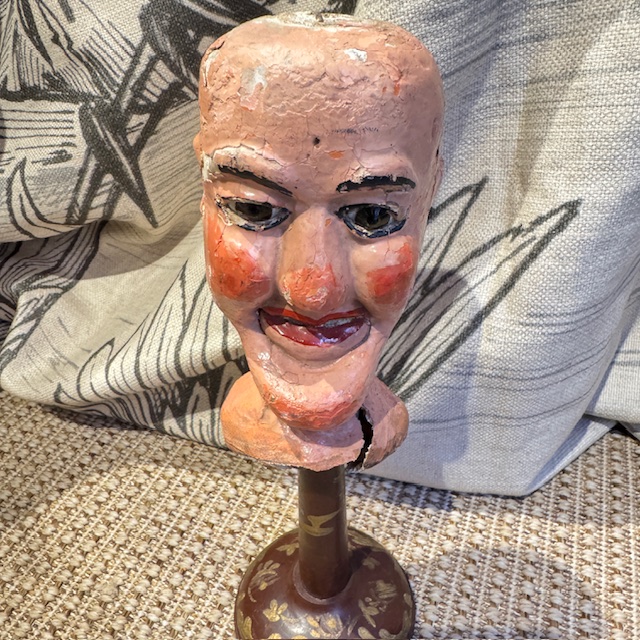
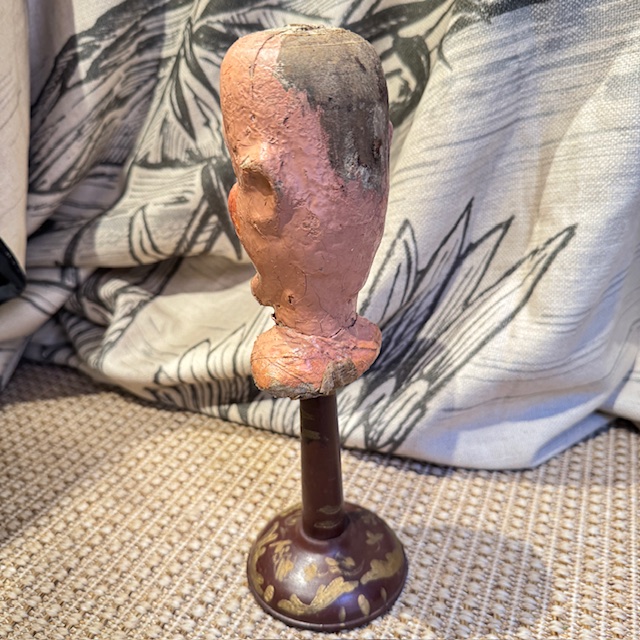
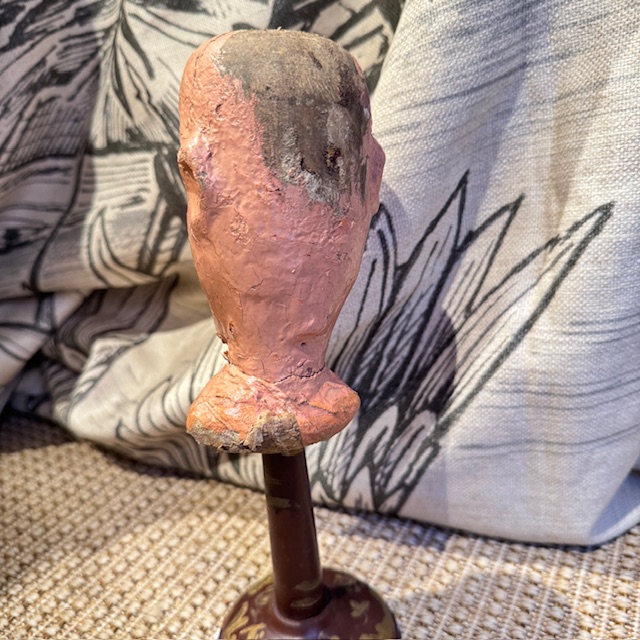
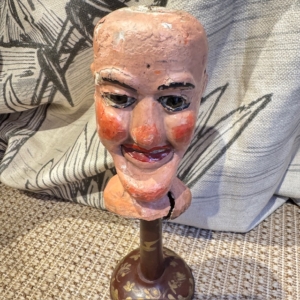
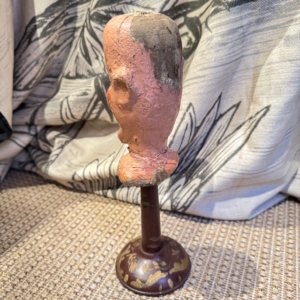
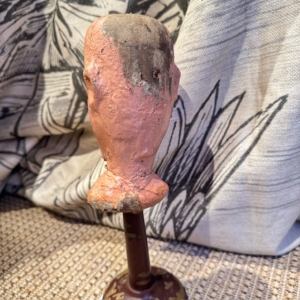
The puppet head in question—carved in wood, modelled in plaster and hand-painted—belongs to that vibrant universe. Its glass eyes, flushed cheeks and exaggerated smile are signature features of Punch & Judy characters, where the grotesque and the comic coexisted with total naturalness.
Every detail seems designed to be seen from afar: a bold expression strong enough for a child sitting at the very back of a beach crowd to follow the unfolding story.
Time has left its traces—a small crack, softened layers of paint—adding a deeply human quality to the object. It’s easy to imagine it resting inside a wooden trunk as the troupe travelled from show to show, or sitting on a workbench while Quisto touched up each figure before the next performance.
Placed today on its original stand, this puppet head is more than a theatrical relic: it is a fragment of a craft that survived wars, changing fashions and entire cultural shifts. One of those rare objects that, when you look at it, somehow seems to look back.
This post is also available in: Spanish