

Description
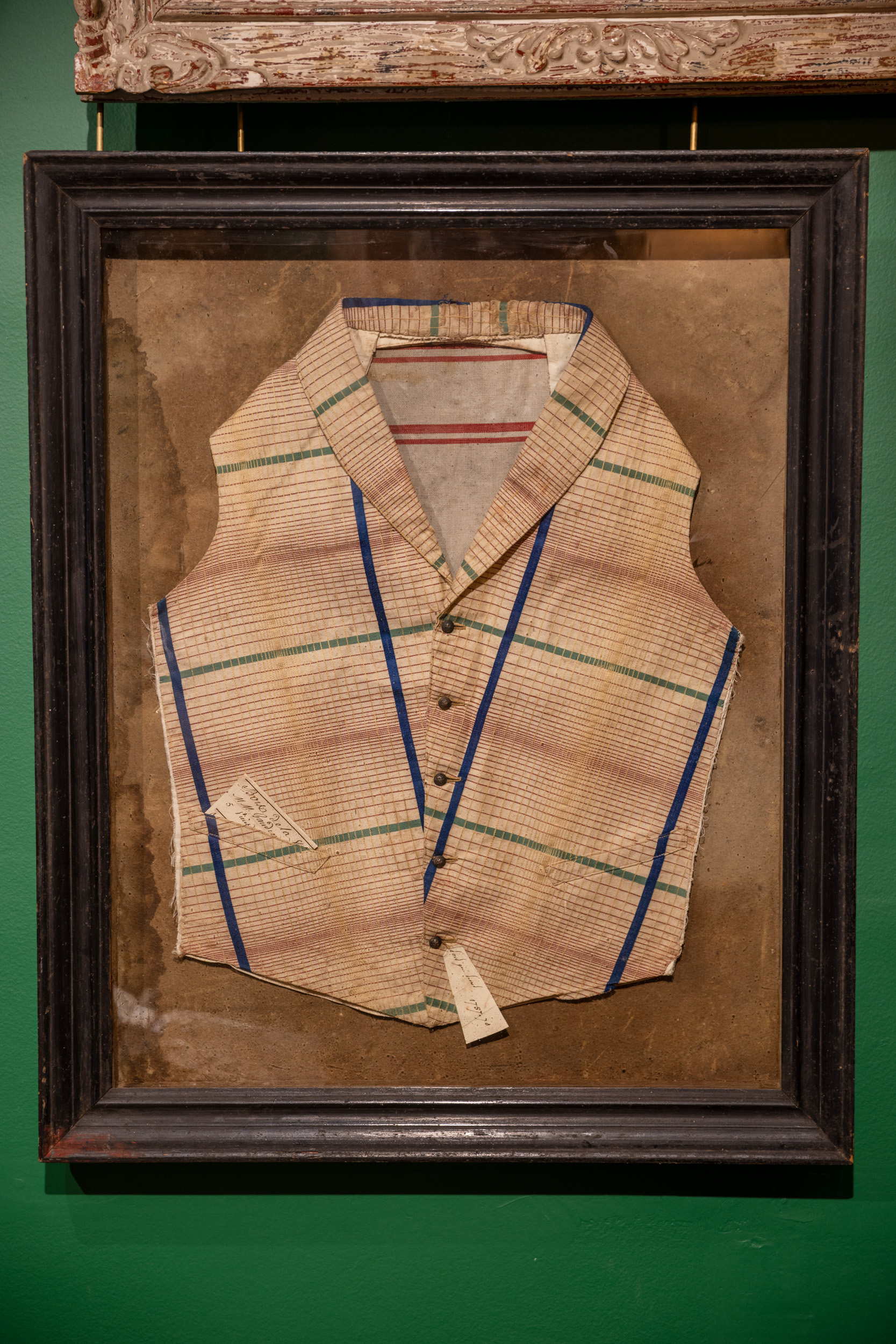
This 19th-century French vest, framed and suspended in time, preserves the geometry of an era when dressing was an act of identity. Its woven pattern of soft ochres and blue lines speaks of craftsmanship, of those precise stitches that once shaped the quiet elegance of 19th-century men’s fashion.
Each line seems to tell a story —of mornings marked by the ticking of a pocket watch, of hands fastening buttons before stepping out, of a folded note slipped discreetly into the pocket. The kind of gestures that fade in memory but remain stitched into fabric.
In 19th-century France, the vest was more than clothing; it was a marker of class, of decorum, of aspiration. It belonged to that in-between space—between worker and merchant, between public life and private thought. This one, with its balanced design and honest material, might have belonged to a craftsman, a teacher, or a traveler crossing Europe by train with only a suitcase and a destination.
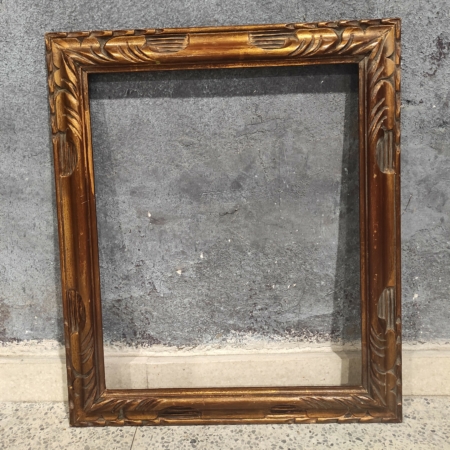
Today, transformed into antique textile art, it becomes a unique piece of vintage wall decor—a fragment of lived history. The aged wood frame and the linen softened by time make it quietly powerful, its simplicity carrying the weight of authenticity.
To frame a piece like this is to preserve more than fabric; it’s to frame emotion itself.
That moment where the tangible and the intangible meet, where beauty is not about perfection but about presence.
At Deco for Curious, an antique shop in Bilbao, we believe that certain objects don’t just decorate—they endure. Each carries a pulse, a whisper of life once lived. And perhaps that’s why they move us: because through them, time feels less distant, and memory a little more human.
This post is also available in: Spanish