

Description
Some garments hold more than fabric — they hold presence.
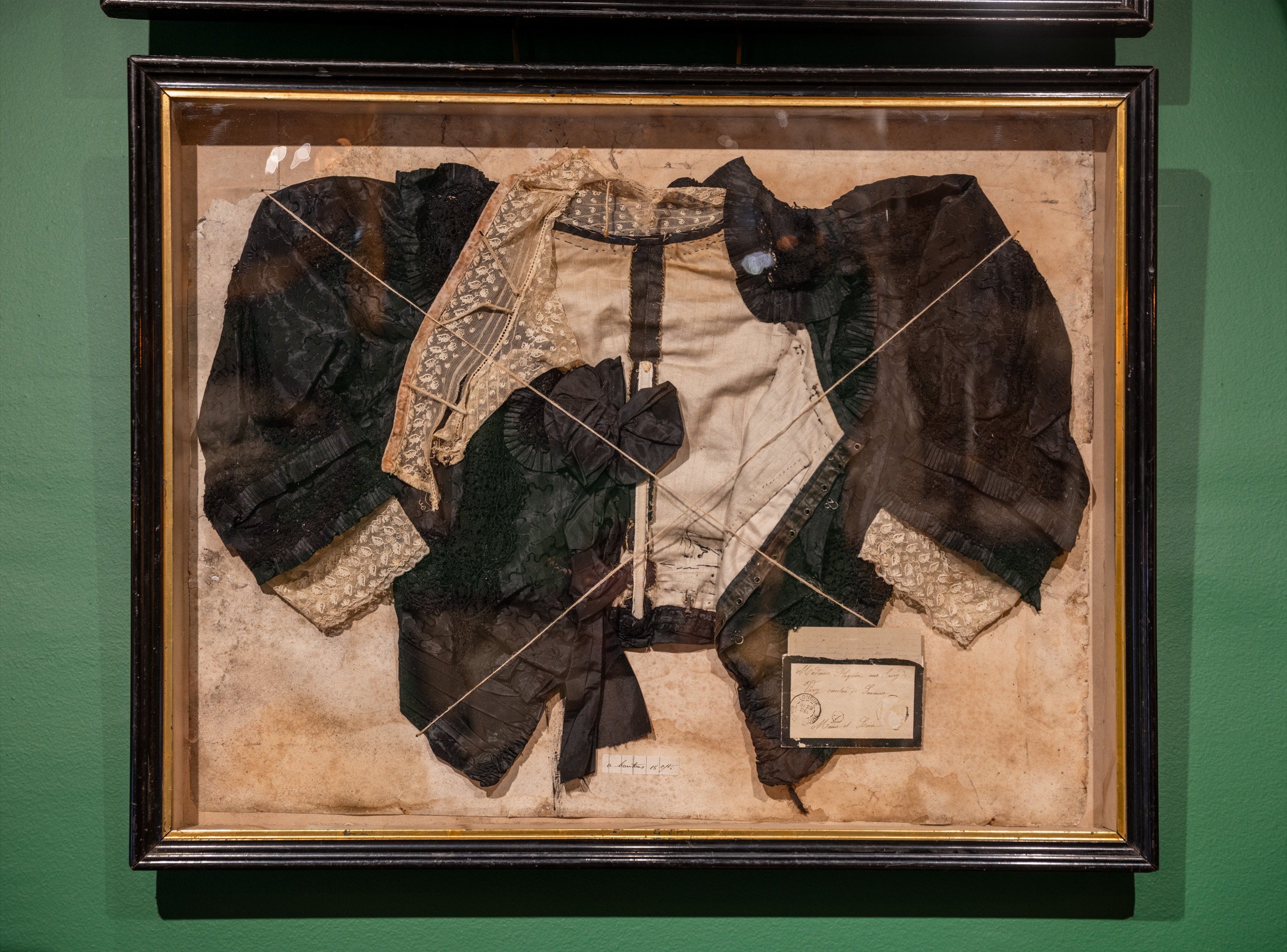
This 19th-century French jacket, framed and preserved like a relic of another life, seems to breathe softly behind glass. Its folds still remember the shape of a body, the motion of hands fastening it, the quiet rhythm of a day long gone.
The texture — silk darkened with time, lace yellowed by age — stretches like a map of memory. If you look closely, you might imagine the faint sound of fabric brushing against wooden furniture, or the scent of perfume still lingering from a century ago.
This jacket belonged to a world in transition.
In 19th-century France, clothing spoke before words did. It carried identity, class, geography, even emotion. While revolutions and railways were redrawing the map of Europe, garments like this became markers of refinement and resilience.
Now, enclosed in a handcrafted frame, it has crossed from fashion to art — a vintage wall piece where history and beauty coexist. Each mark, each wrinkle, each thread tells a story no restoration could ever erase.
The background paper, softly speckled by age, becomes part of the composition. The lace contrasts with darkness, the past folds into the present. There’s a kind of stillness to it — as if time itself had agreed to pause for a moment.
At Deco for Curious, an antique shop in Bilbao, we are drawn to pieces like this: objects that whisper, that don’t insist on being seen, but once you do, you can’t quite look away.
A jacket turned antique textile art, preserved not as fashion but as memory.
How many lives can fit into a single piece of fabric?
This post is also available in: Spanish