

Description
Some engravings don’t just show what a body is made of —they whisper how knowledge was once built, line by line, in the quiet rooms of early anatomists.
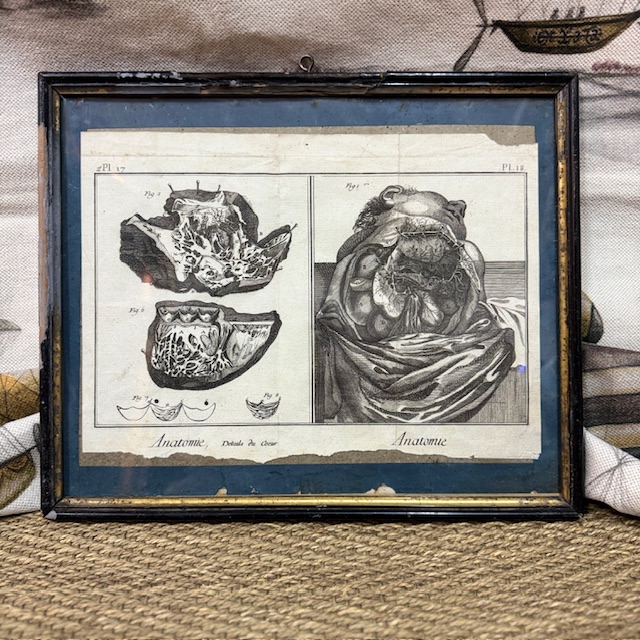
This 19th-century French print is one of those pieces.
Before photography became the scientific witness we now take for granted, illustrations like this were the way the world learned to look inside itself. They were drawn by hand, often in cold studios attached to hospitals or universities, where artists and doctors worked side by side, trying to capture the invisible with astonishing precision. You can feel that intention here: the textures, the cross-hatching, the almost sculptural shading that gives the organs an eerie, solemn beauty.
Mounted on a deep petroleum-blue passe-partout —a colour that was wildly popular in late-19th-century France— this engraving carries a presence that doesn’t need to shout. It brings a touch of Cabinet des Curiosités energy, that blend of elegance, oddity and fascination that transforms a wall into a conversation.
In Deco for Curious, we’ve always had a soft spot for pieces like this: objects that hold a trace of human curiosity, of the obsession for understanding how things work, of the gentle drama of old scientific imagery. It pairs beautifully with vintage furniture, dark woods, eclectic art walls or even ultra-minimal interiors that crave a single note of character.
Some people see an anatomical study. Others see a relic from a time when science still felt like storytelling.
Tú decides qué historia continúa a partir de aquí.
This post is also available in: Spanish